Monday, 7 March 2011

Food laws: why we should eat less meat and more bread and wine


Sermon on Deuteronomy 11: 18, 26-28, 32; St John’s, New Hinksey, Oxford; 6th March 2011

Well , I am delighted to be here today to preach to you. One of the reasons for me being here is that I understand from my friend Margaret Rayner that the issue of Jewish food laws was raised during a sermon a few months back and she thought that I might have something to say on the subject and so Father James invited me along.

I should say at this point that I am really no expert on the Jewish food laws but I am interested in food - as many of us are. But in addition to enjoying cooking and eating it I am also a food researcher. During the week I am employed by the University of Oxford to run a research group called the British Heart Foundation Health Promotion Research Group which is based in the Department of Public Health and my research group carries out research into healthier eating. Some would say we are responsible for the traffic-light labelling of foods you can find on some foods sold in the UK.

I also happen to think that we don’t think and speak enough about food within our churches: food is fundamental to human existence and identity but we can so readily take it for granted.

Moreover a meal is the central act of Christian worship and yet we can so easily come to see the Mass, the Eucharist as purely symbolic and forget that what we share is – as well as being the body and blood of Christ – real bread with real nutrients made with real wheat grown in real fields by real farmers who are often the people to suffer most when times are hard, and real wine made with real grapes from real vines and containing real alcohol to make us really glad.

If you think about it for a moment bread and wine are amazing things.

No wonder then that the Bible has a lot to say about food from the fruit of the tree of knowledge that was eaten by Adam and Eve in the Garden of Eden, to the fruit of the tree of life that we are to share at the end of time, at a heavenly banquet, according to the writer of Revelation.

No wonder too that rules about food were central to the Law of the Old Testament. Our Old Testament reading today – while not mentioning the Jewish food laws in particular - does talk, in general, about the laws God gave to Moses to pass on to the Children of Israel. They come in a section of the book of Deuteronomy which starts: ‘This is the law which Moses set before the children of Israel; these are the testimonies, the statutes, and the ordinances, which Moses spoke to the children of Israel when they came out of Egypt.’ The last of today’s verses from the Old Testament was: ‘And when you possess [the land your God gives you] and live in it, you shall be careful to do all the statutes and the ordinances which I set before you this day.’

The writers of Deuteronomy go on to set out these statutes and ordinances in Chapters 12-27 and these chapters contain the food laws. These foods laws can also be found in the book of Leviticus earlier in the Old Testament (Chapter 11). Some of these food laws are well known such as, ‘Only be sure not to eat the blood [of animals]’ (12: 23) and, ‘The swine because it parts the hoof but does not chew the cud is unclean for you’ (14: 8) – which means that the Jews were forbidden from eating pigs. Some are less well known such as, ‘Of all that are in the waters you may eat these: whatever has fins and scales you may eat. And whatever does not have fins and scales you may not eat’ (14: 9). This of course means that the Jews should not eat shellfish such as oysters and crustaceans such as lobsters.

Today I want to suggest that these food laws – despite being rarely preached on – are worth thinking about – because they reveal things about the goodness of God and his relationship with his creation which we might otherwise miss. In the Old Testament there are major rules - such as, ‘Thou shalt not kill’ – one of the Ten Commandments – and minor rules such – ‘Thou shalt not eat lobsters’ just as there are today in 21st Britain. We are still not allowed to kill people (naturally) but there are a host of minor rules that we also have to follow such as, ‘Thou shalt drive your car on the left’ – or to take two food related examples, ‘Thou shalt not sell flour mixed with chalk dust’ and, ‘Thou shalt not sell food which has passed its sell by date’. These minor rules are not unimportant: in fact they are vital for the smooth running of society. It was not just the ancient Jews who had food laws – we still have them today.

But of course the Jewish food laws sound slightly strange and odd. Why for example were the Jews forbidden from eating pigs? Many people have suggested that Jewish food laws are an early form of the sorts of food laws we have today – designed to ensure that people don’t get sick when they eat. There may be some truth in this –for example humans catch diseases from the animals they keep and pigs are particularly dangerous in that regard. Think swine flu here. This is because pigs are omnivores not herbivores and we therefore tend to feed them on scraps including animal products that have passed their eat-by-date and this in turn means that pigs can also be housed in much greater proximity to us than sheep, goats and cows.

But the laws clearly are not just written for public health reasons. I want to suggest they tell us a lot about God and his relationship with Creation and they therefore make no sense without first thinking about some of the first stories in Genesis and in particular what they say about food.

There is a lot about food in Genesis. We learn from Genesis 1: 29 that humans when first created were vegetarians, or more accurately fruitarian – eating just fruits and seeds not even roots and leaves. In other words the ideal state for humans is to be fruitarian. And this I think is interesting given the increasing realisation that we eat much too much meat today – too much for our own health but also too much for the health of the planet. The Brazilian rain forests are being destroyed – at great cost to the environment – to fuel our insatiable lust for burgers. But this is not to say that we should all turn fruitarian or even vegetarian at once.

Adam and Eve may well not have eaten any meat. There is no record that they did and but their son Abel – certainly did. He was a herder of sheep and presumably ate some of them. You’ll remember that Abel the first herdsman gets killed by his brother Cain the first farmer essentially over a dispute about which type of food production method God preferred.

But the first time we hear that God gives explicit permission to humans to eat meat is after the Flood. When the waters have subsided Noah and his family leave the ark and rather strangely start killing and cooking – as a sacrifice - some of the animals that that have been their companions for the last 40 days. This was supposed to be for God’s benefit but it is not at all clear that God wanted this. But he does then, and only then, seem to shrug and say, ‘OK if you must eat meat you must. But when you do you must do so reverently.’ He tells them, ‘Every moving thing that lives shall be food for you: and as I gave you the green plants, I give you everything’ (Genesis 9: 3), i.e. ‘It is only now that I give you animals, as opposed to plants, to eat’. But he also says, ‘Only you shall not eat flesh with its life, that is its blood’. He gives a reason for this, which he connects with a prohibition against the violence that humans are clearly prone as demonstrated by the story of Cain and Abel: ‘For your lifeblood I will surely require a reckoning; of every beast I will require it and of man; of every man’s brother I will require the life of [a] man. Whoever sheds the blood of man, by man shall his blood be shed.’

This is a difficult couple of verses but this is the first explicit law to be found in the Old Testament if you discount the prohibition from eating of the fruit of the tree of good and bad. And it connects permission to eat meat, with both a restriction on the way meat should be eaten (without blood) and a prohibition against men killing men and so shedding blood. It says, I think, something very profound about food and violence. It means also that the later Jewish food laws that we are thinking about today are all about animals rather than plants, all about meat rather than fruits, vegetables, grains and the things they are made from such as bread and wine.

So Noah is told that any animals can be eaten but only to be eaten if they must and then only in a particular way. Why does God, through Moses, then announce that certain animals are not to be eaten at all? We surely all feel that certain animals should not be eaten. We know instinctively that it’s wrong to eat our pets and other animals that we have formed a relationship with e.g. by giving them a name; we feel that it is wrong to kill and eat animals that are nearly as intelligent as ourselves us such as chimpanzees; we have a sort of gut feeling that we shouldn’t eat animals that eat other animals particularly dead animals like vultures. Eating animals is then something which is deeply problematic. God through Moses tries to give us some help here.

What the texts before and after the food laws in both Leviticus and Deuteronomy emphasise is that by following them the people will become holy just as God is holy, that being created in the image of God humans should behave like God the creator.

The creation accounts in Genesis suggest that heavenly bodies – the sun, moon and stars – plants and animals, including humans, were created according to an ordered plan in relation to:
• place (the heavens, the waters and the land),
• whether they move (plants no but heavenly bodies and animals yes),
• whether they have life (heavenly bodies no, animals yes).
• If animal how they move, (walk, fly, swim or swarm/slither),
• their form or other words the notion of something being ‘according to its kind’, and
• what they should ideally eat (animals: all plants and humans fruit and seeds).

The process of creation is therefore one of separation, into different places, static and moving beings, inanimate and animate beings and then animals including humans according to their locomotion, their form and how they sustain life.

The food laws suggest that what is contrary to this plan is not perfect, is not holy and therefore ideally should not be eaten.

Re. place. All plants that grow in their rightful place - on land - are by implication good and nearly perfect for sustaining life. Animals with no proper or an ambiguous place to live, such as reptiles and amphibians are not.

Re. movement and locomotion. Animals that move in appropriate ways such as animals that live in water but walk as on land such as lobsters are imperfect, as are those that live on land but swarm as if living in water (such as wingless insects, spiders, centipedes, insect larvae). In Genesis 1 tells us that the swarmers belong in the waters.

Re. form: Animals with an indefinite form (such as oysters and other shellfish) with a deceptive form (such as eels (fish that do not look like fish)) or an incomplete form (such as animals with a cloven hoof) are not perfect and thereby contrary to God’s perfect plan.

And finally animals that do not conform to the original idea that animals should only eat plants are not to be eaten, i.e. animals that eat other animals or do not chew the cud, the mark of ruminant animals that eat what God originally gave all animals to eat: green leaves of grass and other plants.

You can I hope begin to see that what at first sight might seem a random set of prohibitions turns out to have a logic to it and is closely connected with God’s plan for creation by separation.

And just as the food laws embody this idea of creation by separation, the food laws themselves became are one of the means by which the Jews came to see themselves as distinct, as separate from other people. At the end of Leviticus God calls on the Children of Israel to keep the food laws so that ‘You shall be holy to me, for I the Lord am holy, and have separated you from the peoples, that you should be mine’ (Leviticus 20: 26). Clearly eating certain foods and not others separates us from others even today. Think of the way vegetarianism or food allergy, becomes for some an important, even major, part of their identity.

I would suggest that customs and laws around food are important in defining us all. I have tried to show that the Jewish food laws remind the Jews not only of the created order but of God the creator of order, not only of the intelligible separation of forms but of the mysterious source of form, separation and intelligibility. Of course the coming of Jesus heralds a new covenant, including a transformed set of rules for God’s people to follow. One of the consequences of this is that Christians need no longer follow the Jewish food laws, but this does not mean we can just forget them.

Furthermore Jesus has given us some new instructions around foods. This is to remember that whenever we eat bread and drink wine we are to remember his life, death and resurrection. The observance of this instruction amongst many other things, makes us, a separate, a holy people. Just as the Jewish food laws were designed to remind the Jews of the God the Creator the Eucharist reminds Christians of God the Saviour. It brings together the sacred and divine with the ordinary and every day and thus recalls the incarnation. It is not just the solitary eating of certain foods and not others: it is a shared meal. It reminds of the God who is a trinity of relationship.

I said near the start of this sermon that I hoped, that in thinking about the Jewish food laws, we might discover things about the goodness of God and his relationship with his creation which we might otherwise miss. The Eucharist tells us so much about God than the Jewish food laws but as a foreshadowing of the Eucharistic instructions I think the Jewish food laws still have their value. In particular they remind us to eat meat- and indeed other foods such as bread and wine – only with reverence and care.


Acknowledgement. Many of the ideas in this sermon come from Leon Kass and in particular his book 'The hungry soul: the eating and perfecting of our nature', 1991, Free Press.

Monday, 21 February 2011

Mary, Martha and touch


A partial explanation for my choices of pictures in six pictures of Mary and Martha.

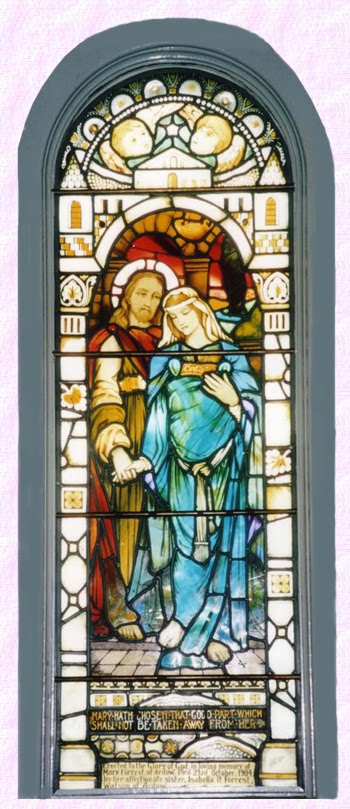
Andrew, when I gave this ‘sermon’ yesterday at St Luke’s you said that the picture of Jesus and Mary of Bethany in the stained glass window was disturbing because it takes us close to Da Vinci Code territory and another friend of mine, Liz, has said the same when she ‘read’ my blog. I thought I’d better explain this choice of picture. I couldn’t at the time because someone changed the subject of ‘touch’ and ‘intimacy’ in the pictures so abruptly. I think because it made them feel uncomfortable.

I chose the picture of Jesus holding Mary of Bethany because it is rare example of a picture of Jesus touching a woman in a way that speaks of intimacy with them. There are others I have found e.g. there is an interesting modern picture of Jesus with the Samaritan woman which some people find shocking because Jesus and the woman’s legs are touching (I’ll blog it some time soon). Pictures of Jesus touching men except to heal them or rescue them from drowning (Peter) are even rarer!

There are some pictures of people (mostly women again) touching Jesus and pictures of the story of the woman (sometimes Mary of Bethany, sometimes Mary Magdalene and sometimes difficult to say) anointing the feet of Jesus with perfume are the most common. But it should be noted that in many of the foot-anointing pictures the woman is not shown actually touching Jesus. The picture by Stephen St Claire makes the point that she could not have put the perfume on Jesus’ feet and wiped it away with her hair if she did not touch them. It is perhaps why some find it such a disturbing image.

Why do we find pictures of Jesus touching people or people touching Jesus so disturbing? It is of course because all four gospel writers are clear that Jesus was unmarried and didn’t appear to have a wife/partner. He did though have friends – some of whom like Mary and Martha of Bethany and Mary Magdalene were women. It seems to me highly likely that Jesus touched his friends and his friends touched him. This is what friends do. When people love one another they touch one another because touch is a form of deep communication.

Of course people touch one another when they have sex and this is surely what has made artists avoid showing Jesus touching people and people touching Jesus. But of course touch is not just for sex, it’s also for reassurance e.g. when holding the hand of a child to lead them somewhere or in other (non-western) cultures when holding hands with a friend when walking together. Touch also brings comfort. A person will put their arm around a friend – or even someone they don’t know very well - who is going through a difficult time to comfort them. And finally touch can be healing as when the woman with a haemorrhage touches Jesus (Luke 8: 40-56, etc) and as when Jesus touches people when he heals them. (Interestingly artists are reasonably happy to portray Jesus touching people when he’s healing them.)

This brings me back to the picture of Jesus and Mary of Bethany in the stained glass window. This picture is all the more ‘disturbing’ because Mary is clearly pregnant. Dan Brown’s Da Vinci Code is based on the pretence that Jesus had a sexual relationship with Mary Magadalene and there is not a shred of evidence for this. It has never been suggested that Jesus was any more than friends with Mary of Bethany. Why then does the artist portray Mary of Bethany as pregnant? Who knows? But why should she not have been? Women do get pregnant. Is the artist implying that the father of the baby is Jesus? Would it be that shocking if he was?

Why are we so afraid to see Mary of Bethany or Mary Magdalene’s anointing of Jesus’ feet for what it clearly was – an act of great love and tenderness - and so ready to turn it into something else? John (and Matthew and Mark) but not Luke clearly sees the anointing as foreshadowing Jesus’ anointing after his death (but surely again this is an act of particular intimacy). There is no suggestion that kings’ feet were ever anointed but some have been ready to see the anointing as something to do with Jesus’ kingship. And if its ‘just’ an anointing why the business with the hair?

As I said yesterday there seems to be some confusion amongst the gospel writers about who it was exactly that anointed the feet of Jesus and wiped the perfume away with their hair. John has Mary of Bethany anointing the feet of Jesus. Luke has it that it is Mary Magdalene who does so – or rather in his account it is ‘a woman of the city who was a sinner’ and a few verses later introduces Mary Magdalene to his readers. In Luke’s gospel Mary of Bethany just sits at his feet rather than anointing them. (Matthew and Mark do not name the woman and she pours the perfume over Jesus’ head). So in theory it could be both Mary of Bethany and Mary Magdalene/someone else entirely. Artists are similarly confused as reflected by the picture in my blog by Vergilius Master and often conflate the stories from Luke and John as in the picture by Blake. (Is that a perfume jar or a cushion? If a jar is Martha criticising Mary for pouring the perfume on Jesus’ feet but if so shouldn’t that then be Judas?)

One of the reasons why I think the confusion between Mary Magdalene and Mary of Bethany is interesting is that the first (traditionally) represents sex and the second friendship/intimacy. In Luke’s gospel the first is a risky prostitute in need of forgiveness (c.f. Luke’s story of ‘Mary Magdalene’ anointing Jesus’ feet (Luke 7: 36-50)), the second commendable (c.f. Luke’s story of Mary of Bethany sitting at Jesus’ feet like an attentive friend (Luke 10 38-42)). Whilst in John’s gospel it is Mary of Bethany who does the anointing and Mary Magdalene is the friend who meets Jesus in the garden after his resurrection and (significantly?) isn’t allowed to touch him.

Who then was it that anointed the feet of Jesus and wiped the perfume away with their hair? The prostitute or the intimate friend?

Sunday, 20 February 2011

Punting and the eternal now


Sermon on 1 Corinthians 9:24 - end; Matthew 20: 1-16.

In today’s sermon I want to focus on Paul’s idea that the Christian life is like a race. This is a metaphor that is fraught with problems to my mind. Though Paul being Paul I must admit it has its merits. And of course Paul’s letter to the Church at Corinth is in the bible whereas my sermon in the Church of St Matthew’s is not.

The race metaphor has it merits and its problems for me personally but I will argue that it also has its merits and problems irrespective of my reaction to it.

I react badly to Paul’s race metaphor because I dislike competitive sport. We talk a lot about sport at lunchtime where we work. In answer to the question, ‘What sport do you enjoy then, Mike?’ I usually say punting [boating with a pole rather than say an oar]. Punting for me is the sport par excellence. It involves physical activity and that is good for you. I spend a lot of my working life trying to work out how we can get peopled to do more physical activity (as some you may know). Punting also involves a fair amount of skill and therefore when you get it right you feel good – akin I imagine to what footballers feel when they score a goal or tennis players feel when they deliver an ace.

But - and more importantly – like a few other sports – jogging, gardening, cooking –punting is not competitive. (Although I must confess I do enjoy steaming past American tourists going round in circles under Magdalen Bridge or from bank to bank a little way further up the Cherwell.) Furthermore with punting there is no goal – or if there is it is to return to where you have started from – and there is no prize for achieving any goal.

Although not competitive punting is also a sport best enjoyed with other people. There really is not much fun in punting a punt by yourself. It’s quite nice if the others in the punt can punt as well but it actually doesn’t matter if they can’t or if they do so badly. It’s a co-operative rather than competitive sport in other words, and as such is hardly likely to become recognised as an Olympic sport.

Running races, in contrast, are the epitome of competitive individual sport. The winning of them depends entirely on the strength and skill of the individual. ‘Team GB’ is surely a complete fiction. Athletes are not part of a team: they are individuals competing against one another. In contrast the winning of team sports – like football or even doubles at tennis – depends not just on the skill of the individuals in the team but the way those individuals work together.

But note rather paradoxically that running races need other people by definition. You cannot have a race, let alone win one, without at least one other person. Unless you imagine you are running against yourself: yourself as another person as it were.

Another thing I really dislike about competitive sport is the discipline. In today’s passage Paul talks about the discipline that is necessary if you are going to win the race that is the Christian life. Now I am not a very disciplined person at the best of times. I have confessed to some of you before that I am not even disciplined enough to clean my teeth everyday let alone read the Bible every day. As of course all good Christians – let alone priests - are supposed to (both clean their teeth and read Bible that is). I am just about disciplined enough to get to work, most days, before 10.30 and come to Church on most Sundays. But I sorely lack discipline in my life.

So Paul’s race metaphor irritates me. But as I said at the start, Paul’s letter to the Church at Corinth is in the Bible so it needs to be taken seriously and I have to admit the race metaphor does have some merits. It reminds us that whatever we might like to think, life – by its nature – is somewhat competitive. Even if we don’t want to see ourselves as competing against other people there are trials and tribulations that need to be overcome with God’s help. ‘Lead us not into temptation’ in the Lord’s prayer, reminds us, if we ever need reminding, that life is not a bed of roses, or a bowl of cherries or some other metaphor.

There is – also whether we like it or not – an end point – death. We might not wish to see this as a goal but we do need to prepare for it otherwise it might steel upon us unawares like a thief in the night. This preparation for death involves discipline.

Increasingly I have come to realise that time runs out. When we are young we think we have all the time in the world. As we get older we realise that there are important things to be done for the future. They may not be particularly pleasant to do. No one surely likes brushing their teeth and reading the Bible is not particularly enjoyable most of the time but these things are necessary for our oral and spiritual health respectively. Paul is surely right to remind us that ‘Every athlete exercises self control in all things’ and to suggest that we should be like athletes in this regard in all aspects of our lives.

It might be more pleasant to see life as more like a punting trip than a running race. Surely Paul could have at least mentioned relay races! But we have in the end to cross that finishing line by ourselves.

All this being said I still think Paul’s race metaphor leaves much to be desired because it is only half the story. A friend of mine used to accuse me of never living in the present – always only ever doing things for the future. And it was (is?) true. As just one illustration of this: I used to read classic novels at best to improve my mind at worst to be able to say that I had read them. I would never stop reading a book even if I weren’t enjoying it or leaning anything from it because the important thing was to get to the end.

It is possible to see life as a continual preparation for something later. But what is this ‘later’: our death, our funeral, the after-life? If we see the Kingdom of God as something solely in the future then we may see getting there as more important than how we get there. Or even that how you get there doesn’t really matter in the grand scheme of things. Paul gets close to this I think when he says that ‘I pommel my body and subdue it, lest after preaching to others I myself should be disqualified’ presumably from the race. Or in other words training may be painful but that doesn’t really matter it’s the winning that is important.

Jesus in his teaching talks paradoxically about the Kingdom of God being both here and not yet. He thus subverts people’s notion of time. If we think of time in the conventional sense then today’s parable of the labourers in the vineyard makes Jesus unfair. If the labourers who turn up at the eleventh hour get as much for their labour as the labourers who start work in the morning then the householder is surely being unjust to those who work for 12 hours not just “generous” to those who work for one . Though “generous” may not be the right word as one denarius a day was only just a living wage.

Time in the Kingdom of God, however, is not time as we understand it. The parable teaches us – amongst other things – that the reward for our work in this life- the prize for winning the race - is a gift not something that depends on how much time we have spent in working in the vineyard or time spent training for the final race of our life. And this prize, this gift, can in fact be claimed now.

Or in other words heaven is now as much as it is in the future. It is difficult to keep hold of this idea and yet – as I said just now – Jesus talks as much about the Kingdom of God as here and now as he does about it coming in the future. Some of Jesus’ parables of the Kingdom do, as this does, take place over the course of a period of time – a day or from planting to harvest, etc - with the denouement at the end. But many speak of the Kingdom as happening now – the parables about banquets, yeast, salt, etc.

And Jesus tells his disciples that they are to look for signs of the Kingdom now, prisoners being released, people healed, wine produced in abundance. If we look around at our damaged world it is difficult to see heaven as now and yet all true followers of Jesus do I think grasp – if only faintly – what Jesus was saying.

Yes life is a race or at least a journey with a start and an end. There is a prize to be won – the ‘incorruptible crown’ as Paul puts it. But the coming of Jesus means that we are in touch with the eternal and the eternal is no respecter of time. ‘Let us not only live FOR the ultimate, but let us also live IN the ultimate. Then life's purpose is not a goal set before us in the future. It is a present, living reality in which we participate now, even as God does.’

This quote is from De Vern Fromke, See: http://rogeraubrey.typepad.com/roger_aubrey/quotable_quotes/

Tuesday, 8 February 2011

Six pictures of Mary and Martha


In order these are by: 1) Velasquez, 1618 2) Anon (from Kilmore Church on the Isle of Mull) 3) Stephen St. Claire, contemporary 4) Ain Vares, contemporary 5) Vergilius Master, 1410 6) William Blake, ~1800.

Six questions about each in turn:
1) Who is the old woman behind Martha?
2) Is Mary really pregnant? (the caption reads: Mary hath chosen that good part which shall not be taken away from her)
3) Is this Mary of Bethany or Mary Magdalene and were they the same person?
4) Is that a washing machine?
5) Who (again) is the woman on the left?
6) Why are most of the guests women?

Sources: Luke 10: 38-42; Luke 7: 36- 8: 3; John 12: 1-8; Mark 14: 3-9.
And a really interesting blog post by James Tabor at http://www.jesusdynasty.com/blog/category/biblical-expositions/


Sunday, 6 February 2011

The parable of the wheat and weeds: insiders and outsiders


Sermon on Matthew 13: 24-30, Colossians 3.12-17, St Matthew's, Oxford, 6th February 2011.


The first verse of our Epistle reading: ‘Put on therefore, as the elect of God, holy and beloved, bowels of mercies, kindness, humbleness of mind, meekness, long suffering; forbearing one another and forgiving one another’ is such a great verse - particularly in this translation. And there is, of course, a connection between this verse and our Gospel reading – the parable of the wheat and the tares or wheat and weeds. In the Epistle Paul is urging the Colossians to forgiveness and forbearance of those amongst them who seem to be straying. This surely connects with the parable: a parable, Jesus says, about the Kingdom of God. In the parable the sower – the owner of the field – says, ‘Let both wheat and weeds grow together until the harvest’. And I assume this is the connection between the two passages Cranmer had in mind when he put them together as today’s two readings.

So let’s look a bit more at the parable with this connection in mind.

In Matthew’s gospel the parable of the wheat and the weeds comes immediately after the parable of the sower and immediately before the parable of the grain of mustard seed. But Matthew is the only one of the gospel writers to report it – whereas Mark and Luke both have the parable of the sower and the parable of the grain of mustard seed. All three parables are about seeds growing which surely means that Matthew sees a connection between them.

Both the parable of the sower and today’s parable feature weeds as well as wheat. The weeds in both parables grow amongst the wheat. In the parable of the sower they are thorns/thistles which choke the wheat but in the parable of the wheat and weeds the weeds are probably what has become known as darnel – a plant that looks a bit like wheat. It does not harm the wheat, just does not produce anything that can be eaten.

In the parable of the sower the weeds are seemingly more successful in their rate of growth but in the end clearly aren’t going to produce any grain. We aren’t told what happens to them as they are only marginally important to the story. In the parable of the wheat and weeds the servants of the sower ask whether they should be weeding out the weeds with the implication that they think they should, but the sower tells them to be patient and wait until the harvest when they will be burnt.

The parable surely invites us to see ourselves as the wheat and the weeds as other people: other people who in some ways resemble us but who are fundamentally different from us: non-believers if we are believers, but perhaps also believers if we are non-believers, gay if we are heterosexual, men if we are women, etc. But does it suggest that we should treat these other people differently – even reject them - as a consequence?

Well yes it probably has been taken to suggest this over the years – not exactly helped by Matthew’s account of Jesus’ explanation of the parable. This comes a few verses later after the parable of the mustard seed and the parable of the yeast (another sort of seed?). Here Matthew has Jesus say explicitly that the ‘Weeds are the sons of the evil one’ and that ‘Just as the weeds are gathered and burned with fire, so will it be at the close of the age’. This is all rather difficult to swallow. These weeds might be our friends even if they aren’t exactly like us.

No wonder then that many theologians argue that the interpretation did not belong to the parable from the outset. They even suggest that the explanation was largely composed by Matthew and badly reports what Jesus actually said. They note that the explanation focuses on the weeds and what happens to them whereas the parable itself is clearly as much about the wheat as the weeds and, in particular, the need to be tolerant of the weeds until the harvest.

There is likely some truth in this. Jesus rarely offers interpretations to his parables. And when he does, he does so only to his disciples. Jesus is generally reluctant to discuss his parables. Just a few verses before the parable of the wheat and weeds Jesus is being questioned by his disciples about why he tells parables. He says, rather opaquely ‘This is why I speak to them in parables, because seeing they do not see, and hearing they do not hear, nor do they understand.’ This, amongst other things, surely means that there is no one simple explanation of a parable.

And in this regard it is interesting, I think, that Matthew does not put the interpretation immediately after the parable – possibly because he wants to set the parable in the context of these other parables about seeds. And it is not to say that Jesus never gave an explanation of a parable or the particular interpretation of this one. It is to say that there may be more than one interpretation of the parable and to suggest that there are lots to this parable besides the rather simple explanation Matthew has Jesus give.

Moreover Jesus’ parables are clearly not just stories told to instruct. They are – as I have said before - designed to change peoples’ way of thinking. They always contain something shocking or even confusing designed to make those who hear them, and are prepared to try and understand them, consider things differently. So what is shocking about the parable of the wheat and weeds? Would people be more shocked about the ultimate burning of the weeds or the sower allowing the weeds to grow amongst his crop until the harvest?

Setting the parable of the wheat and weeds in a group of parables about seeds invites the reader to compare and contrast the parable with the other parables but also to think what it also has to say which is distinctive.

In all three parables the seeds represent something different but note that in all three parables the good seed: the seeds which fall on the fertile ground, the wheat seeds and the mustard seed and the wheat seeds all grow into something much greater than previously: they bear fruit in other words. The Kingdom of God is where things grow!

But the parable of the wheat and weeds is distinctive – presumably deliberately distinctive - in that when the goods seeds grow the plants cannot, initially at least, be distinguished from the weeds and when they do their roots are intertwined so that the owner of the field tells his servants not to try and separate them ‘lest in gathering the weeds you root up the wheat along with them’.

A very surprising and confusing thing here –designed to shock its listeners into thinking about things differently - is why the growth of the wheat and the weeds should be virtually indistinguishable from one another and all growing together in one place until the harvest. It’s probably only we who are shocked by the subsequent burning of the weeds.

Or in other words Jesus is surprising his listeners (and surely us) when he is suggests that it difficult to say who is a member of the Kingdom of God and who is not. And indeed like the servants of the sower, anxious to uproot the weeds even if that would damage the wheat – we are urged not to try. We know from our own experience that we are always tempted to divide people into people like us and people who are not, those who we like and those who we don’t, goodies and badies. Christians seem peculiarly tempted in this regard. Witness the furore about homosexuality within the church and before that….

But Jesus tells us that it is sometimes the least obvious person who turns up trumps in a difficult situation. Who would have thought it was going to be the Samaritan who helped the traveller who got mugged on the journey from Jerusalem to Jericho. Furthermore Jesus –by associating with prostitutes, tax collectors, etc. turned upside down peoples’ perceptions of the rightful members of the Kingdom of God.

Instead of trying to distinguish and root out the weeds amongst we ‘should put on bowels of mercies, kindness, humbleness of mind, meekness, long suffering; forbearing one another and forgiving one another’ And we should leave judgement to God.

Sunday, 16 January 2011

‘Look Up!’


Sermon at St Matthew’s, 16th January 2011; readings: John 1: 29-42, Romans 8: 12 - 17

The theme of my sermon today is ‘Look up’. Steve [our vicar] chose this theme when he was devising the term card because of two verses in today’s set reading from John’s gospel. This describes two occasions where John the Baptist is talking to his disciples; Jesus approaches and John says, ‘Look, the Lamb of God!’

I am going to talk about both words in the theme of ‘Look up!’: firstly ‘look’ and secondly ‘up’. So first: ‘Look!’

Well hopefully that woke you up and secondly it might have actually made you look. If you were looking at me you would have looked at where I pointed and where I myself looked. Look is what is known as a performative word. In other words it’s one of those words which makes things happen rather than just describes something.

There are in fact lots of performative words. We tend to think of words as merely describing states of affairs and some words do indeed have this purpose. So when I say, ‘this pew is brown’, I am merely describing something – something rather self-evidently true in this case. Those of you at the back, who can’t see this particular pew I am pointing to, might want to come out and check for yourself that I am telling the truth, but I guess you won’t bother to get out of your seat.

There are lots of words that don’t describe things so much as do things. A very good example is, ‘I promise’. The two words means nothing until you actually utter them and then they change everything (particularly during a marriage service). Commands are a particular class of performative word.

When John describes Jesus as the Word of God – in that famous verse at the beginning of his Gospel - ‘In the beginning was the Word, and the Word was with God and the Word was God’ - he doesn’t just mean that Jesus is the truth: here to tell us how things are. He means that Jesus - the Word of God – has come into the world to change everything. The Living Word is a peformative word.

And when John the Baptist says ‘Look!’ he doesn’t mean, ‘I think, Andrew and Philip, you might find that this man Jesus is the Lamb of God’. He says, pointing to Jesus, ‘Look, the Lamb of God!’ He is commanding them to see for themselves that Jesus is the Lamb of God.

‘Look!’ as well as being a command is a word which re-orientates the person who obeys the command. Those of you who were awake when I shouted ‘Look!’ just now hopefully looked up from whatever you had been looking at previously: perhaps at your fingernails thinking that they might need cutting, or at the notices at the back of the service sheet (which are sometimes more interesting than the sermon I find), or wherever. If you did look you presumably looked at me to see where I was looking. Then you would have turned your eyes away from me to see what I was looking at or pointing at, which was, incidentally, the lit candle on the altar, which you then might have noticed, even thought about for a while, before turning back to look and listen to me (or to reading the notices in the service sheet).

So the word ‘Look!’ reorientates us to a new state of affairs. It’s a bit like the word ‘Repent!’ in that regard. ‘Repent!’ is a word that John the Baptist was particularly fond of. But unlike the word ‘Repent!’, ‘Look!’ doesn’t involve thinking about ourselves before we change our orientation. It just involves focusing on something other than what we have previously been looking at.

So to the second word in our theme of ‘Look up!’ What do we mean by ‘up’ here? Well traditionally we think of God as up. Heaven is up and God resides in heaven doesn’t he? And I guess that’s what Steve had in mind when he came up with this theme. And of course when John the Baptist says ‘Look!’ he is telling his disciples to look at Jesus: Jesus the Lamb of God. I don’t personally think heaven is up above but I think it is useful to think of God as being somewhere other than where we personally are. Nowadays people seem more inclined to find God within themselves or within other people, and of course there is good biblical support for this idea but it has its drawbacks as I hope will become clearer.

Now a definition of spirituality that I find helpful is that it’s about connecting firstly with God, secondly with other people and thirdly with ourselves. I mean connecting and not just loving. For a start connecting is as much about being loved as much as loving. Moreover connecting with persons has to involve communication and this can involve other things besides love such as criticism, rebuke, complaint, thankfulness, promises, etc. But of course love is the most important thing involved in connecting with God, with other people and with ourselves and without love those other things are like a clanging cymbal.

This Jesus makes this clear in his answer to the lawyer who asks him ‘What shall I do to inherit eternal life?’ Jesus says (quoting Deuteronomy and Leviticus), ‘You shall love the Lord your God with all your heart and with all your soul and with all your strength and your neighbour as yourself.’

So we are commanded to love, to connect with God, but we also need to love, to connect with other people and with ourselves. I don’t really want to talk about connecting with other people today and its relationship with connecting with God, but I do want to talk about the similarities and differences between connecting with God and connecting with ourselves.

On the one hand – as Jesus reminds the lawyer – we do need to love ourselves otherwise it’s going to be difficult to love others and perhaps even God. We are made in the image of God, God loves us so there is something good about us which is worthy of love. We are not just ‘miserable offenders’ despite what the Book of Common Prayer might be taken to suggest. And so there is a sense in which we need to connect with ourselves if we are to become whole, fully functional human beings in the way God wants us to be.

On the other hand this proper regard for ourselves can become unbalanced. It is easy to become obsessed with ourselves. Sometimes we become obsessed with our qualities, but much more commonly we become obsessed with our faults and inadequacies. This is illustrated by the titles of self-help manuals which in the old days might have given you tips on relationships with other people – ‘Men are from Mars, Women are from Venus’, etc. - but are now increasing concerned with our relationships with ourselves. And in particular our self esteem and self confidence.

In preparing for this sermon I did a quick search on Amazon for ‘self help books’ and here are four titles from the first 20 of 104,578 results:
• At number 6 The Little Book Of Confidence;
• At number 10 Healing Your Emotional Self: A Powerful Program to Help You Raise Your Self-esteem, Quiet Your Inner Critic, and Overcome Your Shame;
• At number 16 The Girl's Guide to Loving Yourself: A Book about Falling in Love with the One Person Who Matters Most...You ;
• And at number 17 Instant Confidence

Now I haven’t read any of these books and you might say I therefore have no right to criticise them.

Here is a book I have read: Eat, Pray, Love by Liz Gilbert. Or rather I am two thirds of the way through it. Some of you might have read the book or seen the film. According to the Sunday Times, ‘Eat, Pray, Love has been passed from woman to woman like the secret of life’. Err well yes perhaps.

It’s not a self-help book though I guess it does aim to provide advice. It’s an account of one year in the life of its author who has until recently been settled in a large house with a husband who wanted to start a family. But she finds she doesn’t want any of it. A bitter divorce and a rebound fling later, she emerges battered yet determined to find whatever she has been missing. She begins her quest in Rome where she indulges herself in Italian restaurants and gains nearly two stone. Next she travels to India, where she lives in an Ashram scrubbing the floor of the Temple and meditating. Finally she ends up in Bali, where - according to the blurb on the back - a toothless medicine man reveals a new path to peace, leaving her ready to love again (but I haven’t got to that bit yet).

Liz Gilbert is clearly on a quest but it’s very unclear whether this is to find herself or God. She talks about God throughout the book but it seems to me she also confuses God with herself. Here is an extract from the beginning of the book where Liz Gilbert is reflecting on the time when she first prayed.

“Of course I’ve had a lot of time to formulate my opinions about divinity since that night on the bathroom floor when I spoke to God directly for the first time. In the middle of that dark November crisis, though, I was not interested in formulating my views on theology. I was interested only in saving my life. I had finally noticed that I seemed to have reached a state of hopeless and life-threatening despair, and it occurred to me that sometimes people in this state will approach God for help. I think I’d read that in a book somewhere.

“What I said to God through my gasping sobs was something like this ‘Hello God. How are you? I’m Liz, It’s nice to meet you.’

“That’s right – I was speaking to the creator of the universe as though we’d just been introduced at a cocktail party. But we work with what we know in this life, and these are the words I always use at the beginning of a relationship. In fact, it was all I could do to stop myself saying: ‘I’ve always been a big fan of your work…’.

“‘I’m sorry to bother you so late at night’ I continued ‘But I’m in serious trouble .’[I’ve missed out a bit here]

“‘Then I heard a voice. Please don’t be alarmed - it was not an Old Testament Hollywood Charlton Heston Voice, nor was it a voice telling me I must build a baseball field in my backyard. It was merely my own voice, speaking from within my own self. But this was my voice as I had never heard it before. This was my voice, but perfectly wise, calm and compassionate. This was what my voice would sound like if I’d only ever experienced love and certainty in my life. How can I describe the warmth of affection in that voice, as it gave me the answer that would forever seal my faith in the divine?

“‘The voice said ‘Go back to bed, Liz’”

Now it’s not clear to me whether Liz Gilbert thinks that the voice that she heard was God or her true, her better self or indeed whether she thinks the two might be the same thing.
And I guess that there is a sense in which we too can never be entirely certain that when we speak to God we aren’t speaking to ourselves. Furthermore when, as sometimes happens, I hear God speaking to me, I am never utterly certain that I’m not hearing from myself. This is where faith comes in.

But what I think we – as Christians - can be sure about is that we are not God. That God is a person – or rather three persons in one - that is entirely different from ourselves. This means that to look up, look towards God is to look away from ourselves. And if we are to believe and follow Jesus it means that it is, at least at times, essential to look towards God, rather than towards ourselves.

Obsessive concern for ourselves is called egocentricity and of course none of us are immune from the problem. It even, I think, creeps into our worship.

It was recently pointed out to me that the chorus of the song beginning ‘Light of the world you stepped down into darkness’ is just a tad egocentric. It goes, you’ll remember:


Here I am to worship,
Here I am to bow down,
Here I am to say that
you're my God
You're altogether lovely
All together worthy,
All together wonderful to me

This sounds suspiciously like the prayer of the Pharisee in Jesus’ parable of the Pharisee and the tax-collector. You’ll remember Jesus tells this parable of two men who went to the temple to pray. The Pharisee prays one type of prayer and the tax-collector another and Jesus says that it’s the tax-collector’s prayer – which is simply ’God be merciful to me a sinner’- which is the one God wants.

Both the Pharisee’s prayer and the song start well. Both are addresses to God. ‘Light of the world you stepped down into darkness’ is fine. Similarly the Pharisee starts with the words, ‘God I thank thee.’

The problem with the Pharisee’s prayer is not particularly what he thanks God for: which is ‘not being like other men‘ - he may well have been that - but his obsession with himself. He goes on to tell God (as if God didn’t know) ‘I fast twice a week; I give tithes of all I get’. Is this very different from, ‘Here I am to worship; here I am to bow down’?

I am sorry if I have just spoiled this song for you. I actually rather like it. I like the tune and most of its words are OK. I think we just need to be a bit careful in how we address God when we sing to him.

And the remedy for egocentricity in our songs, in our prayers, in our lives? Well it’s the Lord ’s Prayer. I said earlier that in looking up we orientate ourselves towards God and this is precisely what the Lord ’s Prayer does.

Firstly it’s worth recalling there is not a single mention of the word I in this prayer. There are we’s and there are you’s but no I’s

Secondly In the original Greek the payer begins ‘Abba’ which is best translated as ‘Dad’. Now ‘Dad’ or ‘Abba’ - rather like ‘Look!’ - is a performative word that reorientates us by making us focus on the relationship we have with God. ‘Abba’, of course is usually translated with two words ‘Our Father’ which taken together sort of does the job of ‘Dad’ but not as well I think. ‘Dad’ makes you pause after you have said it and we often start and run into this prayer so fast that we don’t have the have to the chance to remember who we are saying it to.

Thirdly whilst there are five us’s in the prayer in this prayer there is only one we. Give us today our daily bread, forgive us our sins… who sin against us, lead us not into temptation, and deliver us from evil. The one we comes in the words ‘as we forgive those who sin against us’. This prayer is not about what we can do for God (except in this one instance – forgiving the sins of others) it’s about what God can do for us.

Fourthly before we get to the first us there are three you’s. After the initial ‘Dad’, the prayer makes us focus even more on who we are talking to though the words ‘hallowed be your name, your Kingdom come, your will be done’. There are then three you’s before we get onto the petitions: the things we are asking for ourselves. And after we have asked for daily bread, forgiveness of sins and protection from evil, the prayer brings us back to you again, with the words: ’For the kingdom, the power, and the glory are yours, now and for ever’.

The Lord ’s Prayer is not just a model prayer, it’s a model for the way we should lead our life. The essence of the Christian life is that it’s oriented towards God. We too should obey John the Baptist’s command ‘Look, the Lamb of God!’ as often as we can. But we don’t have to do this solely in our own strength. As Paul says in the reading from Romans we heard earlier, ‘When we cry Abba, Father, it is the Spirit himself bearing witness with our Spirit that we are children of God’. When we look up, God will look down on us and draw us to himself.

Thanks to Joanna Collicutt for some of the ideas in this sermon.

Monday, 3 January 2011

The Visit of the Shepherds and Revolutionary Christianity


Sermon on Luke 2: 15-21 (and Romans 4: 8-14) St Matthew’s, 2 January 2011

Luke’s story of the shepherds visiting the baby Jesus in his manger is all of a piece with one of the big theme in his gospel: that Jesus is on the side of the poor and powerless.

Here at Jesus’ birth the first people to come and see him are shepherds – who for the most part were viewed as lower class in first century Palestinian society and certainly weren’t very well off. At his resurrection the first people to see him alive will be a group of women who then - as for much of the intervening centuries – were seen as second class to men. Luke is always putting poor and powerless people at the heart of his story about Jesus.

Where Luke has shepherds visiting the baby Matthew has Magi – important religious figures who, when they turn up in, what is for them, a foreign country, appear to have instant access to the ruling authorities (in this case King Herod). The visit of the Magi is full of symbolism about the true nature of kingship and power but sounds a bit implausible to me – who would actually bring a baby gold, frankincense and myrrh: surely a rattle would be much more appropriate. The visit of the shepherds always seems somewhat more realistic - a real spontaneous response by a group of ordinary people to an event which somehow they grasp is going to change the world for them.

Luke throughout his gospel is much more concerned with Jesus’ impact on ordinary people than the powers that be. This isn’t to say that he is unconcerned about power-relations in society and in particular the relationship between rich and poor, the powerful and powerless.

On the contrary Luke is, for example, much more interested, than say Matthew, in Jesus’ political teaching about poverty and oppression. Matthew does record Jesus speaking about these things but he tends to see Jesus speaking of them in spiritual rather than physical terms. When Luke speaks of poor people – he means people who don’t have a lot of money. When Matthew speaks of poor people – he means people who are spiritually impoverished. Of course this exaggerates the difference in perspective because Luke knows that people who are financially poor are less likely to have time for spiritual things and Matthew knows that those who are financially wealthy are going to have greater problems with Jesus’ spiritual demand to give up everything in order to follow him. But in general Luke sees Jesus as ‘biased towards the physically poor’ whereas Matthew seems to see this less clearly.

This difference in perspective of the two gospel writers is reflected in the debate about Jesus’ teaching that has echoed down the ages. Is the good news for everyone or is it only for those who God has special regard for.

The gospel reading – as well as recording the visit of the shepherds – also records the circumcision of Jesus and the epistle reading picks up on this. Paul in his letter to the Romans is arguing that the coming of Jesus makes it clear that it’s not circumcision which makes you a member of God’s chosen people but faith (and even suggests that ‘twas ever thus – that people just hadn’t really seen it that way before). In other words Paul is saying that the good news of the birth, life, death and resurrection of Jesus is for everyone – not just a select few who have gone though a particular initiation right.

We are now fairly used to the idea espoused by Paul in his letter to the Galatians that ‘There is no Jew nor Greek, there is neither slave nor free, there is neither male nor female, for you are all one in Christ Jesus’ – even if it has taken around 2000 years for us to take this on board. But does this mean that God has no special favourites anymore? Isn’t he biased towards the poor and powerless? Does he not have special regard for these people?

I would suggest that the good news of the gospel is good news precisely because Jesus has come primarily (as he himself claimed at the very start of his ministry) ‘to preach good news to the poor..proclaim release to the captives and recovery of sight to the blind, to set at liberty those who are oppressed’ This isn’t good news for the rich and powerful. It’s not even saying ‘I have come to warn the wealthy oppressors that they better change their ways. It’s arguing that what he says and does will have a direct impact on marginalised, poor and powerless people – like the shepherds that night in the fields outside of Bethlehem – regardless of what establishment, rich and powerful people do.

This is why I want to have a gentle dig at Archbishop Rowan William’s Christmas sermon this year. I quote

"Faced with the hardship that quite clearly lies ahead for so many in the wake of financial crisis and public spending cuts, how far are we able to sustain a living sense of loyalty to each other, a real willingness to bear the load together? How eager are we to find some spot where we feel safe from the pressures that are crippling and terrifying others? As has more than once been said, we can and will as a society bear hardship if we are confident that it is being fairly shared; and we shall have that confidence only if there are signs that everyone is committed to their neighbour, that no-one is just forgotten, that no interest group or pressure group is able to opt out."


This is all well and good as far as it goes: but it is essentially a warning to the rich and powerful not good news for the poor and powerless. (And I must say at this point that I count myself as one of the former rather than the latter) Even so as warnings to the rich and powerful go it isn’t really of the same tenor as Jesus. Rowan respectfully asks about how far we are able to do things like ‘bear the load together’ and gently chides us about our tendency ‘to find some spot where we feel safe’. In Luke’s account of the Sermon on the Mount Jesus says ‘Woe to you that are rich for you have received your consolation, woe to you that are full now for you shall hunger’. Not exactly gentle chiding.

Rowan Williams is also urging a greater sharing of what we have and a greater commitment to our neighbour. Jesus says much the same thing later in his ministry (the miracle of the feeding of the 5000 and the parable of the Good Samaritan spring to mind). And we rich do need to be reminded of these things. But where is ‘the good news for the poor’? Isn’t Rowan William’s just saying that if we rich and powerful don’t help build the Big Society (or whatever you want to call it) then the poor and powerless will suffer.

I am reminded of a book I got for Christmas by a Marxist called Terry Eagleton – entitled Reason, Faith, and Revolution: Reflections on the God Debate, This is a devastating attack on the New Atheists like Richard Dawkins, Christopher Hitchens, et al. Eagleton is no Christian but he is brilliant at exposing the New Atheists’ lack of understanding of what Christianity actually is but - as the blurb on the back says – ‘he also launches a stinging assault on what he sees as Christianity’s betrayal of its revolutionary mission’.

We, the church, surely do have something to offer the poor and powerless. Not only practical help – like hostels for the homeless at one level or just neighbourly help at another – but also surely, and perhaps more importantly, a robust critique of modern-day, consumerist, individualistic society. Eagleton reminds us that Karl Bath – one of the greatest theologians of the 20th century described the capitalist system as ‘almost unequivocally demonic’: strong words perhaps – but surely more akin to ‘Woe to you that are rich for you have received your consolation’ than ‘How eager are we to find some spot where we feel safe from the pressures that are crippling and terrifying others?’

Perhaps it is time that the preachers in our churches tackled some of the causes of poverty and powerlessness today – and surely our unjust economic system is one of them.

Jesus came as a baby to turn the world upside down. ‘Blessed are you that hunger now for you shall be satisfied,’ he said. Poor people like the shepherds believed him and came to worship him.

I know it is easy to criticise Rowan Williams for his diplomatic language which, of course, hides much that is revolutionary. But perhaps we Christians, in 2011, should resolve to be more overtly revolutionary – that we as a church should be clearer that we bring good news to the poor. Luke says that the shepherds left the ‘stable’ ‘glorifying and praising God for all they had heard and seen’. It would be good if a few more cleaners, check out staff, and other modern day equivalents of shepherds, left our churches today ‘glorifying and praising God for all they had heard and seen’!


Image from:http://bustravellingtogether.blogspot.com/ (Hope that is OK)