Wednesday, 19 October 2011

A dangerous meal


Sermon on Luke 14: 1-11.

Our gospel reading contains seemingly two stories of unrelated events But according to Luke they happened on the same day, in the same place and one after another. In the opening verse Luke tells us the day of the week: a Sabbath but also where they took place: the house of a leader of the Pharisees and finally the occasion: a meal. Presumably the time, the place and the occasion have meaning in relation to the stories, otherwise Luke wouldn’t have bothered with such details and presumably the events are connected in some way – otherwise why put them together.

The first story is about Jesus healing a man of an oedema on the Sabbath and then questioning some of the guests – Pharisees and lawyers - at the meal about the law and what it says about what you should and should not do on the Sabbath. The second story is of a speech Jesus gives at that meal about where you should place yourself when you are invited to a meal: next to the host or down at the foot of the table. What he tells them is a parable.

So in this sermon I want to say some things about the importance of the context for the two stories and then finally something about the connection between them.

First some things about the occasion: the meal. I think this is really important. Well perhaps you would guess that I would say that – given that I am constantly talking about food in sermons. But I still think it is worth pointing out that the context for these stories was a meal and that we are here today to celebrate a meal. The meal that we are here to celebrate is the communion meal and Jesus himself told us how we were to celebrate it. Jesus, in the gospel accounts, has the habit of transforming all sorts of meals into special occasions. To make them more than they might at first seem: just some eating and drinking amongst people with varying degrees of relation to one another.

Of course at the communion meal we mainly remember Jesus’ last meal with his friends in the upper room but we are also invited, I think, to remember all the other meals that are recorded in the gospels: the meal at the wedding at Cana, the feeding of the 5,000, the meal that is recorded here and so forth. You can see in the way that Jesus behaved in these meals, including this meal, a foreshadowing of the Eucharistic meal.

In today’s reading Jesus yet again transforms a meal into an extraordinary event. Actually the reading breaks off halfway through the meal and there are other things that happen and are said at this meal which also important to our understanding of what’s going on. In our reading Jesus talks to the guests about being a guest. After this he goes onto talk to the host of the meal about hosting a meal – in particular who to invite to such meal as this one - and finally he talks to one of the guests and tells him the parable of the great banquet – which is of course a direct reference both to the Eucharistic meal and the great Messianic banquet at the end of time. He tells him who God invites and how people are likely to respond to the invitation.

Why Jesus had been invited to today’s meal we are not told. But there are some people there that Jesus has already crossed swords with – Pharisees and lawyers. The Pharisees were – to remind you – generally considered the good guys at that time. And ‘lawyer’ is probably better translated as ‘biblical scholar’. It is not clear that any of Jesus’ friends – the disciples - were there. Moreover the meal Jesus has been invited to is not just an ordinary meal it’s a meal to celebrate the Sabbath – a meal that would have had special foods to celebrate the occasion.

Healing a man at such a meal would have seemed a very odd thing to do. What was this man with an oedema – a sort of painful and unsightly swelling - doing there? Was he a guest? Was he someone Jesus had met on the way and brought with him? Luke doesn’t tell us. He just says the man was there.

At first glance Jesus healing the man with the oedema seems irrelevant to the setting. The man is healed, of course, as a visual representation of Jesus’ message that it’s OK to break the law at times. And he goes on to use the healing to illustrate that teaching and to challenge the Pharisees interpretation of the law. Jesus is not saying that the law is useless. He is not saying for example that the fourth of the Ten Commandments: ‘Remember the Sabbath day to keep it holy’ – no longer applies. He is saying I have come to make you think about the Sabbath in a different way.

But I also think he is saying that I have come to make you think of meals in a different way. What were the guests – and indeed the host - to think when a man with an ugly swelling appeared in their midst? Perhaps their first thought would have been: you are putting me off my food, please go away. Jesus however, far from sending him away, heals the man at the meal. Meals he implies are appropriate places to heal people. And this ties in with what he goes on to say to his host about inviting people to meals immediately after today’s reading. He says to him, ‘When you give a dinner or a banquet, do not invite your friends or your brothers or your kinsman or rich neighbours…but when you give a feast invite the poor, the maimed, the lame, the blind’.

This perhaps should remind us that the Communion meal we are about to celebrate is for everyone and we should not just be making welcome our friends and family but the poor, the disfigured, the disabled.

This context of the meal has a much more obvious bearing on the second story. It’s a useful backdrop to Jesus parable about where to sit when you are invited to a meal. I guess most people there thought about what they’d just done when they’d sat down to eat. I am guessing some would have felt guilty because they did jostle for a position near the host. Some might have also found angry that Jesus was criticising their behaviour. Some might have felt smug that they – on that occasion - had done the right thing and not tried to seat themselves near the most important person.

How many of them would have thought that Jesus was not just talking about behaviour in relation to meals but behaviour in relation to all sorts of other things besides? The ‘plot’ for this parable is what has just happened rather than a fictional tale. Jesus could have begun by saying. The kingdom of God is like this: where people are invited to a marriage feast and do not sit down in the place of honour…’ In this parable Jesus is both challenging the guests to behave differently but also announcing a new way of doing things: the new ways of the Kingdom of God that is both here now and yet to come: the Kingdom of God that is also foreshadowed by the Eucharist.

So the context of these stories is a meal. It’s also a Sabbath meal. This reminds us that it’s a meal to celebrate both the day when creation was over and the day of resurrection. The work of healing is best done on this auspicious day as Jesus demonstrates by his healing of the man with the oedema. But also it makes the meal a special meal. The importance of behaving well at such meal is thereby given extra significance. In the parable Jesus makes the meal even more special by referring to a marriage feast.

Finally the third important thing about the context for these stories is the place. The place for the meal is the house of a leader of the Pharisees. The meals Jesus takes part in in the gospels take place in many different settings: a wedding for the miracle at Cana, the upper room for the last supper, the beach of the Sea of Galilee for the meal of bread and fish after the Resurrection. Most of these meals were with friends but not all. The gospels record other meals with Pharisees. Here the host is a leader of the Pharisees but also Luke tells us that some of the guests were Pharisees and lawyers and that they were watching him to see what he would say or do. So not a cosy meal but a risky sort of meal to be present at. Meals are sometimes uncomfortable, unsettling, challenging occasions.

And note that Jesus does nothing to alleviate the palpable tension in the air. In fact he exacerbates it. He makes them all uncomfortable by healing a sick and unsightly man. He criticises the guests for their behaviour and then turns on the host for his choice of guests!

The presence of enemies – rather than friends - at the meal means that what Jesus does in healing the man with the oedema and telling his parable of where to sit when invited to a meal becomes a challenge – a challenge to the status quo. In healing the man with oedema Jesus is clearly challenging the guests – both friends and foes alike to see the law in a completely different way to that of the Pharisees and lawyers. The parable similarly is not just told to commend humility as a virtue (as the Pharisees might well have done) but something much more radical than that. In particular it is to challenge conventional ideas of status. The last shall be first - the man with oedema shall be healed – but not only that the first shall be last.

So through examining context he connection between the two stories in today’s reading becomes clearer. Jesus news of the kingdom is good news because it turns everything upside down but not just for the sake of it. Ultimately the meal at which Jesus is host – and not just important guest - the communion meal, the Messianic banquet – is and is to be a different sort of meal - a challenge to the conventional. But it is also a foretaste of heaven where everything is put right.

Tuesday, 11 October 2011

Free will and the Foresight Obesity Map


Dear Ron (my atheist friend)

All I think I can do is reiterate my opinion that I cannot prove that choices are freely willed rather than illusory but I do want to argue that free will is a useful concept because it leads to the idea of responsibility and without a notion of responsibility (and indeed blame) you can’t solve problems that relate to human behaviour. Some of these problems are the ‘big’ problems of our age like global warming, the Afghan War, etc. but here is an example taken from my world – the world of obesity prevention.

To elaborate on what I mean, here is that Foresight Obesity ‘map’ again (right). If I’d chosen the Afghan War as my ‘problem’ but then the relevant map would have been this.

In the Foresight Obesity map there is no box labelled ‘free will’ because it is not in itself a thing which causes things: things which cause things are shown as boxes in the map. But there are lots of ‘points of entry’ for free will even though the authors of the map have seemingly tried to write free will out of the map as much as possible. This is because they were afraid of making obesity a moral problem and think, rather vaguely, that it can be tackled solely as a scientific [deterministic] problem.

Incidentally if I had my way I would have included a box labelled ‘God‘ in the map but that’s because I am a theistic scientist. This would have been just as rational as some of the boxes they have included such as ‘ambient temperature’! How on earth does ambient temperature cause obesity!? They might as well have put ‘God’ there instead.

Whilst there is no box labelled ‘free will’ there is there is a box called ‘psychological ambivalence’ which might be summarised as something like: the type of thinking which leads to people saying ‘For what I am doing, I do not understand. For what I will to do, that I do not practice; but what I hate, that I do.’ {KJV of Romans 7: 15}. This box is in the map because of one particular psychologist and it was in my view given too much weight because he had much too much say over the way the map was drawn!

Causal relationships are shown in the map by the lines connecting boxes. But the authors of the map seem to have no clear idea of what they mean by a causal relationship. For example: do they think that it is just when an event is consistently followed in time by another event (cf Hume)? Clearly not – at least in some cases - see below! Do they really think that ‘ambient temperature’ causes ‘level of thermogenesis’ in any way that is comparable to the way that the ‘social acceptability of fatness’ causes (according to the map) ’peer-pressure’? But more relevant to our discussion: do they think cause can be agency (cf Kant) at least for some of the links? E.g. do they not think anyone is responsible (has freely willed) anything that happens in the map?

I think that different types of causal relationship need a different type of line in the map. And incidentally we CAN put equations to some of the lines. My research group is doing research which quantifies the link between ‘fibre content of food and drink’ and ‘nutritional quality of food and drink’ (an interesting causal relationship because one thing instantly causes the other without any time delay – so not a Humean type of causal relationship at all.)

Naturally most of the lines between boxes are completely independent of free will e.g. the line between ‘fibre content of food and drink’ and ‘nutritional quality of food and drink’ or between ‘level of infections’ and ‘extent of digestion and absorption’. But some of the lines do involve free choices on the part of human agents and should be shown differently.

In the map are boxes with the implied names of agents within them e.g. ‘parental control’ [read parents]’, ‘media availability’ [read journalists, advertising executives, etc.], ‘education’ [read teachers], ‘effort to acquire energy’ [read consumers]. There are not a lot of agents mentioned in this map. Only the vaguest hint of Government ministers or CEOs of food manufacturing firms for example! Oh what a surprise. And agents – where they are mentioned - have been depersonalised as much as possible.

But the mappers can’t get away without referring to agents at all. How could they? Where we have agents we have choices. And where we have choices we have responsibility: a moral responsibility to behave in ways which reduces the problem that is under scrutiny: in this case obesity.

Just a bit of thought would indicate, surely, that you cannot make a map of causality in such a case - a complex problem involving human beings - without any reference to the (moral) choices of those human beings that are supposed to be acting as causal agents in relation to the problem.

So in the Foresight Obesity map when ‘Education [read teachers’] is supposedly a cause of ‘media availability’ [read the output of journalists and advertising executives] what do they mean here? Don’t they mean something like ‘teachers have chosen to educate advertising executives to advertise junk foods to consumers’? (A bit speculative but I can’t see what else they mean).

And when the map suggests that there is a causal relationship between ‘pressure for growth and profitability’ and obesity through e.g. ‘effort to increase consumption’ who do they imagine is responsible for this pressure. Is it like ‘ambient temperature’ and 'education' just a causeless cause of obesity? (Of course I would have the ‘God’ box linked to ambient temperature!)

The whole problem (of obesity) can surely never be explained let alone solved by reference to a model of causality which fails to take account of different types of causal relationship and in particular the difference between relationships which involve inanimate objects and those that involve animate human beings (either as cause or effect).

Relationships between human beings and other human beings (or indeed their relationship with inanimate objects such as food) necessarily involves choice and therefore moral choices. So parents have a choice about how they control their kids, journalists about what type of articles they write, advertising executives about what type of foods they advertise, teachers how they teach their pupils, consumers what they choose to eat, etc.

This is where free will comes in. I do think it is important to measure and compare this responsibility (perhaps not in the same way as you can quantify the relationship between say ‘fibre content of food and drink’ and ‘nutritional quality of food and drink’) but otherwise where do you start in tackling the problem. Rather too much of the Foresight Obesity map is – to my mind - focused on the consumer (who for example appears in the centre of the map if not by name) and therefore it implicitly makes the consumer the problem to focus on in relation to obesity. You cannot get away from apportioning responsibility whether you like it or not.

The Foresight Obesity map, lauded by some as persuading the British Government to acknowledge that obesity is not just a function of the moral choice of consumers, goes too far in trying (in vain) to remove the moral dimension to the obesity crisis. Fundamentally obesity IS a a result of greed, not just on our part (those of us who are obese) but of all those who contribute to the crisis and that’s virtually everyone.

This started as a reply in a conversation at
http://revdlesley.net/2011/08/28/pete-rollins/

Saturday, 24 September 2011

Contemplative bread making

Here is the script (liturgy) for a contemplative bread making session. Upload it here. This is a slight modification of the one that I used for some contemplative bread making that took place at Holland House, Cropthorne, Worcestershire on the 21st September 2011. To the left you can see a picture of this session – this was near the end when we were shaping our loaves.

Please feel free to use the liturgy yourselves – although you will need to adapt it – and I would really appreciate anyone’s views on how to improve it. It is probably too wordy. I’ve also included instructions for the equipment you’ll need and some (but not many) ‘stage directions’. Finally, at the end, there is a list of biblical verses about bread to read at some point and a recipe ‘card’.

I think that for contemplative bread making sessions you should use flour that has come from locally grown and locally milled wheat as it was at Cropthorne. In Oxford I use Dove’s Farm organic flour to the same recipe. Ideally the flour should be organic or at least produced to some other agreed standard for environmental sustainability such as LEAF. I think you should know – as far as possible – where the salt and yeast have come from. Fresh yeast is best to my mind because it is smellier than dried yeast. I think that is perhaps important that the yeast smells of putrefaction (see Mark 8: 11-21)

I’ve run one of these contemplative bread making sessions twice now and my main reason for doing so is to help people connect with food, where it comes from, and its symbolic meaning.

Bread of course is central to Christian worship but we normally eat it at the Communion Service, Eucharist, Mass, etc without any regard to where it comes from. The exception is where we say this prayer at the preparing of the table:
Blessed are you, Lord God of all creation,
for through your goodness we have received
the bread we offer you:
fruit of the earth and work of human hands,
it will become for us the bread of life.
Making the bread as part of Communion is really just to lengthen this prayer. Hence the liturgy is designed to make us think more about ‘fruit of the earth and work of human hands’ and this is why there is some rather technical material about tractors, petrol, stainless steel salt pans, etc. I am loath to leave this out. But this material is also combined with making use of the ingredients of bread and the processes involved in its production as symbol that these might ‘become for us the bread of life’.

Of course you probably couldn’t make bread as part of a Communion Service on a routine basis! For the two contemplative bread making sessions I have run one had eight participants and one had 15 so not a whole church(?) And if you worry about crumbs at a Communion Service then you’ll worry even more about the mess of making bread. (There’s a bit of a theological question here: ‘At what point does the dough become bread?’)

Moreover bread making takes quite long with lots of waiting around. It takes longer than a regular service. One of the contemplative bread making sessions I have run took a morning and then there wasn’t time to bless, break, share and eat the bread slowly – as one would at normal Communion Service although we did eat one of the loaves with local butter and honey. The other took a day and there was. On that occasion we piled up all the loaves we had made before the table and the priest used one for a ‘traditional’ Eucharistic ceremony. (The liturgy for this I haven’t included).

Please do let me know what you think, particularly if you ever try this yourself.

Tuesday, 6 September 2011

Meditation on eating a satsuma


This meditation is designed to be read to a group where each individual has been given a satsuma. The reader should pause after each paragraph. It should take about 20 minutes to read. It can be done in a church service of say 80 people, or in a small group of about say 10.


I want you to take the satsuma in your hand. Close your eyes for a moment. Feel its shape, feel the texture of its skin: is it warm, cold, hard, soft, rough, smooth?

You will note that the satsuma is a thing but it’s also, a living being just as you are. Savor that for a moment.

Open your eyes. Now try to look at the satsuma as if you had never seen a satsuma before. And indeed you have never seen this particular satsuma before.

For a start therefore, notice that the satsuma has a top and a bottom. The bottom is where it was attached to the tree via a stalk. The top is where there the flower used to be. This being has a history. It has a past, a present now, and a future.

Notice the particular shape of your satsuma: it’s not really a sphere it is flattened at its top and at its bottom.

Now look more closely at the satsuma. See if you can see the remains of leaves round the stalk, the particular wrinkles in this particular satsuma’s skin, any blemishes your satsuma has.

Look at the colour of the satsuma.

[Here is something you might think about: the uniqueness of this situation. You are in a particular place at a particular moment with a particular satsuma. This uniqueness in time and space is primarily because you are holding this particular satsuma. The place or time could be different but the particularity of the satsuma would still make the situation unique. Place and time are, in effect, irrelevant. Heaven is like this: place and time do not matter. What really matters is not where Heaven is or when we will be there, but who - what real beings - are with us. In that sense Heaven - when and where we see God face to face - may well be the placiest of places, the eternal now, the most gloriously material of all meetings – a bit like this meeting with the satsuma]

Now smell the satsuma. Notice the smell of the satsuma itself and notice the smells that it has picked up on the way: from the bag it was carried here in, from your hand.

Now carefully and slowly peel the satsuma listening to the sound it makes as you do so. What noise does it make when you break into it?

Only tear the skin as much as is necessary. Try to keep the skin intact and the segments together. Notice how the white of the inside of the skin and the segments are slowly revealed.

Notice the smell as you peel the satsuma. Notice how the smell of the satsuma that was just a hint before is now released.

Hold the flesh in one hand and the peel in the other. Look at the shape of the satsuma and look at the shape of the peel. Look at their different colours. How different they are.

[Here is something you might think about: What was once one is now two, and for the moment at least, both are just as important as one another. What you can now see – the outside of the flesh and the inside of the peel - no one but you has ever seen. They present themselves to you as the animals to Adam, as nameless until seen by Man, to be met and to be known. And they come to you – as to their God – for your astonishment at their great glory.]

Put down the peel. Hold the flesh in both hands.

Now carefully separate out just one segment. Gently detach it from the others. Listen carefully as you do so: you might be able to hear the faint squeak as it comes away from the other segments.

Look at the segment, its shape and its colour.

Put one segment in your mouth without biting it. Feel it with your tongue. Is it cold, warm, rough, smooth?

Bite it just once. Can you feel the coldness of the juice? What can you taste?

Slowly, very slowly chew the satsuma segment as long as you can and then swallow it.

[Here is something you might think aboutl: What you have seen to be sure is only the smallest part of the uniqueness of your satsuma, the merest hint of the stunning act of being that it is. For somehow, beneath this gorgeous paradigm of unnecessary being, lies the act by which it exists. You have just now reduced the satsuma to its parts but you might have caught the hint that a thing is more than the sum of the insubstantialities that comprise it. Hopefully you will never again say that the solidities of this world are mere matters of accident. Perhaps now you have seen at least dimly that the uniquenesses of creation are the result of continuous creative support, of effective regard by no mean lover. He likes satsumas therefore they are. The shapes, the textures, the colours, the smells, the tastes are a response, not to some forgotten decree that there may as well be satusmas as lemons, but to His present delight. His intimate and immediate joy in all that you have felt, seen, smelt, tasted. With Peter the satsuma says, Lord it is good for us to be here. Yes says God. Very good.]


After: Robert Farrar Capon (1969) The supper of the lamb: a culinary reflection. Doubleday: New York

Monday, 29 August 2011

‘Taking the Cross’ can be fun.


Sermon on Matthew 16: 21 - 28 and Acts 3: 1-16, St Matthew's, 28th August 2011

I wonder what your reaction to today’s theme is and in particular to today’s gospel reading was. Did you think when you heard Carolyn read the gospel reading: ‘That’s amazing’ or, ‘Mmm….very true… I have no problem with any of that’. Or did you think, ‘Yikes …that’s going to be difficult’ or even, ‘That’s appalling’. Friedrich Nietzsche says of such a passage: ‘Such things as this cannot be sufficiently despised’ and, ‘One does well to put gloves on when reading the New Testament’ . He, like many, have found this passage not just difficult but appalling.

Nietzsche particularly objects to Jesus saying to his disciples ‘If any man would come after me, let him deny himself and take up his cross and follow me’. Now I do not wish to deny the importance of this verse, or even to soften its impact, but this is not the only thing Jesus says about discipleship. So this morning before coming back to it, I want to set this verse in context, by talking about discipleship in general, and Peter’s discipleship in particular.

Discipleship is – I think something we should be talking and thinking about at this time of the Church Year. The Church Year is organised around the life of Jesus. It begins, you’ll remember, with Advent, starting in late November, when we prepare for Jesus’ birth celebrated at Christmas. Christmas and Epiphany are followed by Lent when we prepare for Easter. We remember Jesus’ death on Good Friday, his resurrection on Easter Sunday and his Ascension 40 days later. The last thing we really celebrate in the Church Year is Pentecost, when we commemorate the coming of the Holy Spirit. Perhaps over the summer we should be thinking about what happened to the disciples after Pentecost.

Now this sermon comes at the end of a series of five sermons all based on scenes in Matthew’s gospel. And this final scene needs I think to be viewed in the context of those five scenes as well as in the context of what the bible says about discipleship in general To remind you of those five scenes.

First we had the miracle of Jesus feeding the 5,000 (14: 13-21).
Secondly we had the miracle of Jesus’ walking on water (14: 21-36).
Thirdly we heard about Jesus’ confrontation with the Canaanite woman and the miraculous healing of her daughter (15: 21-28).
Fourthly – last week - we had Jesus asking his disciples who they thought he was (16: 13-20).
Fifthly – today’s reading - we have another conversation between Jesus and his disciples (16: 21-28.

Jesus was the main character in all five scenes but Peter and the disciples were also always there - in a supporting role. Peter – as the disciple par excellence if you like - is explicitly mentioned in three of the five scenes and implicitly in the other two. I’ll come back to those scenes in a moment

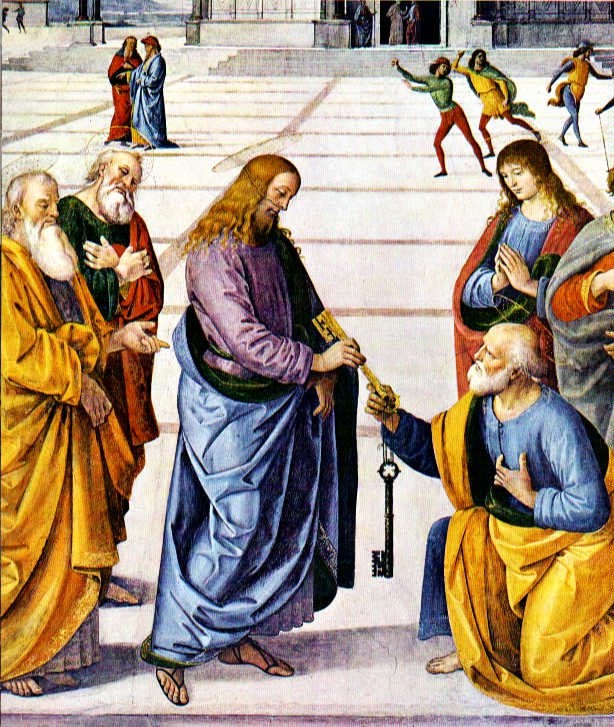
But first a word about Peter. You may remember we recently had a zone service which focussed on Peter. You may also remember that I facilitated the art zone. Two of the pictures were of the scenes from Matthew’s gospel that we have been thinking of. These two: Jesus walking on the water and Peter sinking – by an unknown child as part of the Children Illustrate the Bible Competition (Scene 2) and this one of Jesus presenting the keys of the kingdom to Peter – by Perugino (Scene 4).

It was very easy to find pictures of Peter by many different artists, all down the ages. This is because Peter appears in the Gospels so many times. Think for the moment about Matthew. He only appears three times in his own gospel and what he says on those occasions isn’t recorded. On the other had Peter is mentioned by name 25 times – in Matthew’s gospel alone - and on about half of those occasions we get to hear what he actually said. Peter of course represents all the disciples at times.

What struck me about looking for and collecting pictures of Peter was three things:

Firstly we get to see exactly what Peter is like as a person – particularly though the gospels. He is not just a faceless foil for Jesus. He is such an interesting character. A born leader, brave and decisive but loyal, caring –often demonstrably concerned about Jesus’ welfare - but also impetuous to the point of foolishness and of course, in many other ways, not perfect. At Jesus’ crucifixion his courage fails and he denies knowing Jesus. He’s very wise at times: he gets it. I think we generally think of the disciples as stupid but of course they weren’t, or not all of them. Peter argues with, even challenges Jesus, and of course he gets it wrong sometimes, as in today’s reading.

Secondly – from the point at which Peter meets Jesus - he does such a lot of different and exciting things. Being with Jesus for the three years of Jesus’ earthly ministry must have been an amazing experience. But of course it wasn’t to end there. He gets to meet the risen Jesus and see him ascend into heaven. Then of course he is present in the upper room when – at Pentecost - the Holy Spirit descends like tongues of fire on the disciples. And in Acts we hear more about his life after Pentecost – such as the story of the healing of the lame man we also heard this morning.

In Acts Luke tells us that Peter does various miracles, including raising a young woman – Tabitha – from the dead, gets arrested for preaching the gospel (twice), miraculously escapes from prison (once) and has an important vision about who the gospel is actually for. We last lose sight of Peter – as far as the Biblical record is concerned - at the Council of Jerusalem in around AD50 where we hear what he has to say in discussions with Paul, Barnabas and others about the extent to which Christians need to abide by the old Jewish laws. Oh then we also have two of his letters.

This summary of Peter’s life reminds us that life for Peter went on after his encounter with the earthly Jesus. It was not just the conversation with Jesus we heard about in today’s reading from Matthew – important as that was – it was more than that. I chose today’s second reading from Acts to illustrate this point.

Thirdly, in searching for pictures, I found that most of those pictures also have Jesus in them as well. The pictures are – perhaps not surprisingly - mostly of the Gospel stories rather than the stories from Acts. There are of course no stories about Peter in the Gospels that don’t also feature Jesus. Perhaps Peter’s denial of Jesus is an exception but even then Luke records that Jesus turned and looked at Peter after Peter’s third denial.

Of course we only really remember Peter because of his relationship with Jesus. Ultimately it isn’t really important what he was like or what he did, at least compared with Jesus. The gospel writers and the artists seem instinctively to grasp this and when talking about or painting Peter – it’s Peter’s relationship with Jesus that matters most.

So back to our five scenes from Matthew’s Gospel.

The first two scenes are miracles. The first the miracle of Jesus feeding the 5,000. Peter is not mentioned by name but presumably he is one of the disciples who anxiously point out to Jesus that evening is approaching and the crowd are getting hungry and then helps distribute the bread and fish to the people.

The second scene is the miracle of the Jesus’ walking on the water. Here Peter is explicitly mentioned as trying to emulate Jesus. Why on earth Peter gets out of the boat has never been clear to me and I missed the sermon when I presume Steve explained it. Perhaps sheer sense of adventure?

The third scene is both a miracle and a conversation. Jesus heals the Canaanite woman’s daughter but only after she has persuaded him to do so. Peter again is not mentioned but again presumably he was one of the disciples who came to Jesus to ask him to send her way.

The fourth and fifth scenes are ’just’ conversations between Jesus and his disciples (i.e. no miracles on these occasions) and in both conversations Peter plays a major role.

In the fourth scene which Steve talked to us about last week: Peter seemingly gets it right: very right indeed. He understands – perhaps indeed he is the first to fully understand who Jesus really is: ‘the Christ, the son of the living God’. In the fifth scene – today’s reading - Peter doesn’t get it all. When Jesus starts to tell the disciples what he is going to do: go to Jerusalem, be killed and on the third day be raised Peter tells Jesus that he, Jesus, is getting it all wrong.

Peter misunderstands the word ‘must’ when Jesus says ‘he must go to Jerusalem and suffer many things’. Peter thinks that Jesus means merely that ‘he must’ in the sense that he intends to go. Peter argues with this intention. He assumes that Jesus has a choice. Jesus on the contrary knows that he really has no choice. On the contrary he knows he must go if his life is to have any meaning. Peter’s objection to Jesus saying this is, in a sense, the same as Nietzsche’s. It is appalling that anyone should choose suffering and death rather than life.

On the human level Jesus clearly still does have a choice. Perhaps this is one reason why he reacts so emotionally to Peter challenging him. ‘Get behind me Satan’ is not a rational response to Peter’s – quite reasonable objection to what Jesus has just been telling them. But Jesus calms down and tries to explain. What he says is this:

“Whoever wants to be my disciple must deny themselves and take up their cross and follow me. For whoever wants to save their life will lose it, but whoever loses their life for me will find it.’ It’s virtually impossible to explain this explanation without reducing its challenge.

But here is one thought: By cross – and taking the cross - Jesus doesn’t primarily mean suffering but sacrifice. When Jesus calls us to take up our cross he doesn’t means he is calling us to suffering but to sacrifice.

The cross for Jesus did involve suffering but not suffering just for the sake of it: suffering as a sacrifice. Jesus’ sacrifice through laying down his life changes everything: it means for one thing that there is no longer any necessity for suffering. We certainly do not need to die on a cross. Jesus has done that for us. Death has been overcome so in a sense physical death is no longer necessary - difficult as that is to understand. (If you don’t like the word necessary’ try ‘final’)

But on the other hand discipleship does mean sacrifice. For to find life we need to lose it first –as Jesus says. Now this may sound all very dramatic. Sacrifice sounds a big word but need it be so big a deal. Translate it as ‘letting go’ and it doesn’t sound so scary. Let’s calm down and think of what it means in relation to the first four of the five scenes in Matthew we have been thinking of. They all involve a sacrifice – a letting go on the disciples’ part.

With the feeding of the five thousand the disciples have to let go of their anxiety about the crowd getting hungry. They had to accept that Jesus had things under control, more than just under control that he would provide, and provide he did, so that there was even food left over.

In the walking on water scene – Peter has to let go of his pride and reach his hand out to Jesus to rescue him. Although he thought he was a powerful leader he had on that day to lose some of his self-confidence.

In the encounter with the Canaanite woman Jesus himself has to let go of some of his assumptions about his ministry and the disciples likewise. He and they had to let ago of the idea that the Church was an exclusive club for people like us. Jesus challenges all our conventional beliefs about the way things are and should be. We need to let go of these of these beliefs. Peter recognises this when he acknowledges Jesus as the Christ, the son of the living God.

For Jesus himself sacrifice does mean suffering. But dare it be said – for us, sacrifice can be fun. If we give things up, we will get so much more back.

What did sacrificial discipleship mean in Peter’s case? If we follow his life - from the conversation with Jesus about taking up your cross into the future - we find that it wasn’t all gloom. OK there were some bad bits. His denial of Jesus and Jesus’ death were certainly low points! But there were good times too. His meeting with Jesus after Jesus’ resurrection joyfully restored his spirits and his purpose in life.

Obviously life didn’t stop, either, with Jesus’ ascension. Peter’s life goes on for at least another 20 or 30 years. His is an exciting life as I summarised earlier. His healing of the lame man, in Jesus’ name must have been fun. So too must have been his escaping from prison with the help of an angel. Did he sacrifice much to follow Jesus: yes of course. He left behind a lucrative fishing business in Galilee to preach the gospel. Did he die on a cross or did he die of a ripe old age. We don’t really know and it doesn’t matter.¬

So when Jesus calls us to ‘take up our cross’ is he calling us to a life of suffering as Nietzsche and indeed many Christians seem to think? No I don’t think so. He is calling us to ‘life in all its fullness’. This means that taking up your cross can be fun.

Sunday, 14 August 2011

Sin and riots


Sermon on Romans 8 12-17, St Matthew’s, 14 August 2011:

I was tempted to forget about the Lectionary readings this Sunday and just preach about the riots of last weekend. But then I wasn’t sure I wanted to seem to be add ing to the cacophony of voices that are seeking to explain those events. As Rowan Williams says, ‘Seeking explanations, it is worth remembering, is not the same as seeking excuses' but still there is always a danger that one leads to the other. Nevertheless this week the riots have been at the fore-front of our minds for many of us and it doesn’t seem right completely to ignore them: so I won’t.

Before the riots erupted in our streets I had been planning on talking about sin this Sunday. What I wanted to say about sin is basically this: that sin may seem something powerful and intractable but this is an illusion because Jesus – through his sinless life, death and resurrection – changes everything. I had proposed to talk about sin because, for the last three Sundays our epistle readings have all been from Romans and all have all touched upon the twin – and in Paul’s view related subjects - of sin and death.

Two Sundays ago I talked about death so this Sunday it seemed appropriate to focus on sin. Of course sin is not a subject which is particularly fashionable in most of the circles I – and perhaps you - frequent. When I was younger most of the sermons I sat through seemed to be about sin but nowadays I rarely hear one on the subject. So here is one.

And of course the subject of sin is relevant to the subject of the riots. Theresa May described the riots as ‘sheer criminality’. She might well have said they were ‘sheer sin’, though perhaps she thought criminality sounded worse than sin. And sin is now, of course, a term that people reserve for use in church rather than in secular circles.

At this point it might be worth clarifying what I think sin is.

Firstly of course it’s not just criminality in the sense of breaking the law of the land. There are some breaches of the law – like cycling through a red traffic-light - which are barely sins at all in my book and some sins – like sleeping with you best friend’s partner – which are not breaches of the law. But of course there is a connection between sin and law – God’s law if not man’s law. It might be worth pondering the extent to which one should reflect the other (but not today).

Secondly sin is not just, or even mainly, something we do. Rioting, looting, sleeping with one’s best’s friend’s partner, OK cycling though a red light are sins, sinful acts but they are not the whole of Sin with a capital S. Paul is clear that Sin is a thing – a powerful thing – encompassing, but more than, individual sins and that Sin like Death was a force which Jesus came to overcome. There are lots of verses in Romans which makes this clear e.g.: 6: 23 - ‘For the wages of sin is death; 7: 6 - ’Apart from the law sin lies dead.’; 8: 2 - ‘For the law of the Spirit of life in Christ Jesus has set us free from the law of sin and death’

Thirdly sin is not just something we as individuals are liable to do or liable to be caught up in but also something we collectively do and are caught up in. In this connection I think it is helpful to think of ‘collective sin’ as opposed to ‘individual sin’. And I am not saying that there is no such thing as individual sin, just that it’s not the only type of sin and collective sin may be more important than we generally think. A riot is, in a sense, a type of collective sin which is more than just the sum of the individual acts of vandalism and theft.

We begin to recognise ‘collective sin’ in relation to children. When our children behave badly we feel that it is our fault. Conversely, of course, when they behave well we feel proud. Of course we are not solely responsible for the way our particular children behave: we are not the only reason that they have turned out the way they have, but we are partly.

We may, in addition, feel partly responsible for the behaviour of members of our families: not just our children but our brothers and sisters, our parents, our partners. I think we can see this when we get embarrassed when people we love behave in a particular way. It is as if their behaviour reflects on us in some way.

Then again if we are in a position of authority, at work for example, we may feel responsible at least in part for the behaviour of those who work for us. Perhaps even those who work with us or over us. So we dimly recognise that when others sin we too are implicated somehow. If those people are close to us, or people who we see as our responsibility, then this is easier to appreciate but I would argue that if we could but see it applies to everyone.

In the Brothers Karamazov by Dostoevsky [p335] there is a monk called Father Zossima. Here is an extract from a passage towards the middle of the book where Father Zossima is dying and preaching to his disciples. ‘If you sin yourself and grieve unto death for your sins or for your sudden sin, then rejoice for others, rejoice for the righteous man, rejoice that if you have sinned he is righteous and has not sinned. If the evil doing of men moves you to indignation and overwhelming distress, even to a desire for vengeance on the evil-doers, shun that feeling. Go at once and seek suffering for yourself, as though you were yourself guilty of that wrong. Accept that suffering and bear it and your heart will find comfort, and you will understand that you too are guilty, for you might have been a light to the evil-doers, even as the one man sinless, and you were not a light to them.’

Now we probably feel indignation at the riots. It’s natural and right to do so. They are something which we should feel concerned about, even horrified by. But then the temptation is to look around for someone to blame for them – to feel indignation at the evildoers, in Father Zossima’s terms. Clearly the rioters had a hand in the riots. I am not denying that. But then so did their parents. And then there is the education system, the police, the Government. And what about ourselves? Do we not bear at least some responsibility?

Seeing sin as something bigger than just individual acts of bad behaviour makes sin out to be more pervasive, less easy to ignore, to distance ourselves from, perhaps more important than we have tended to think recently but also surely different to the way the world sees generally sees it. Because Christ has overcome sin, sin for Christians is transformed.

In my sermon two weeks ago I talked about death without talking about sin. And yet in Romans Paul cannot seem to mention the one without the other. There is I think at least three important relationships between the two.

Firstly and most obviously sin and death are connected because one leads to the other. The Genesis story of ‘the Fall’, to which Paul alludes in Romans on various occasions, tells us that in a cosmic sense sin leads to death but we can also see this from our own experience. Sin is destructive of people’s lives, both of the perpetrators and victims. Sin, in its worst expression, leads to the complete destruction of life, to death. It is surely not incidental that the riots began with the death of Mark Duggan in Tottenham, and led to the deaths of Shahzad and Harry Hussain and Musaver Ali in Birmingham.

Secondly sin and death are both something we have difficulties in acknowledging, particularly when it comes to ourselves. They are both taboo subjects. Death because we are afraid of it. Sin because we are ashamed of it. The temptation is always to see them as something that other people might be susceptible to but not something particularly relevant to ourselves.

But for Paul the deepest connection between sin and death comes because it is through Jesus’ death that sin is conquered. Here is the verse just before our epistle reading: ‘If the Sprit of him who raised Jesus from the dead dwells in you, he who raised Christ Jesus from the dead will give life to your mortal bodies also through his Spirit which dwells in you.’ And the first two verse of our reading: ‘So then brethren, we are debtors not the flesh, to live according to the flesh – for if you live according to the flesh you will die, but if by the Spirit you put to death the deeds of the body you will live. ‘

Or in other words: because God raised Jesus from the dead, we are no longer to live according to our old sinful ways. But we have no choice in the matter because if we are driven by the Sprit (as it says in the next verse) we are automatically made children of God – living by a different set of perspectives and indeed rules: ‘If children then heirs…provided we suffer with him in order that we might be glorified with him.’

And here we are back to Father Zossima who suggests that it is only through our suffering that we can we fully appreciate that we are somehow responsible for everything. Here he is again: [p333] ‘Do not say: “Sin is mighty, wickedness is mighty, [the] evil environment is mighty and we are lonely and helpless and [the] evil environment is wearing us away…” Fly from that dejection, children! There is only one means of salvation , then take yourself and make yourself responsible for all man’s sin…for a soon as you make yourself responsible for everything and for all men you will see at once that it is really so, and that you are to blame for everyone and for all things’

Paradoxically perhaps that is only though seeing ourselves to blame for everything that we become free of that blame though the power of Christ’s death. One of the consequences of this is that the Church might consider holding a national day of repentance for the riots: for the rioters, their parents, their teachers, their neighbours, their neighbours’ neighbours, their local councillors, their MP’s, for everyone in fact.

So to summarise: sin in general and the riots in particular may seem beyond our comprehension and without possibility of anyone doing anything about them but this is an illusion because Jesus – through his sinless life, death and resurrection – has already broken the power of sin and this changes everything. The first step in doing something about the riots is for everyone to repent!

Death

Sermon on Romans 6: 3-11 and Matthew 5: 20-26, St Matthew’s, 31st July 2011

There is an obvious connection between today’s epistle and gospel readings summed up by the first verse of the gospel reading which comes in the middle of Matthew’s account of the Sermon on the Mount: ‘Jesus said unto his disciples, Except your righteousness exceed the righteousness of the Scribes and Pharisees, ye shall in no case enter the kingdom of heaven’. Remember that the Pharisees were considered by Jesus’ listeners to be good, morally upright, people –not the hypocrites we have come to think of them as being.

This verse from the Sermon on the Mount is mirrored in Paul’s instruction/advice to the Romans: ‘Likewise reckon ye also yourselves to be dead indeed unto sin.’ In other words we Christians are to lead lives that are exemplary, even though, or even because, our lives have been transformed by Jesus dying on the cross and rising again. As Paul says in the verses immediately before our epistle reading: ‘What shall we say then? Are we to continue in sin that grace may abound. By no means! How can we who died to sin still live in it?’

The problem here is that what Jesus and Paul are saying here doesn’t seem to be borne out by what we observe. Christians do not appear to be any better people than non-Christians. They do not appear to be more righteous than the Pharisees or dead to sin. But I am not going to go into this conundrum today – or at least not tackle it directly – instead I want to say a little about what Paul is saying in this passage about death and dying.

You could say that Paul is not really talking about death as humans experience it in today’s passage from Romans at all. That Paul is explaining how the death of Jesus should change the way we lead our lives; that when he is talking about seeing ourselves as ‘dead to sin and alive to God in Christ Jesus’ he is using death as a metaphor for some sort of altered state prior to our actual death.

Well this may be true but nevertheless Paul does, I think, say some useful things about our actual deaths along the way – because he clearly does not regard death as a wholly negative thing: or rather that now Christ being raised from the dead – death is, no longer, a wholly negative thing

Now death is a subject that we don’t often talk about - perhaps because we do tend to think of it as a wholly negative thing and therefore something we would rather not think about let alone talk about it with other people. And this is slightly odd because we know that if we think and talk about something then we can see it in a clearer light and it become easier to think and talk about. This in particular applies to things we are afraid of. And death is something we are often afraid of.

There is perhaps more discussion about the process of dying these days: with the increasing concern that modern medicine sometimes seems to prolong the suffering that sometimes precedes death – but there is still not a lot of discussion about death itself: the outcome of the process of dying.

But death itself is perhaps something worth thinking about before we get there. Someone recently told me that she thought it was harder to think about death the closer one came to it so perhaps on this basis we should think more about it.

One thing I have learnt recently is that death and what happens after death are not the same thing. Some people seem to fear the former and not the latter and some to fear the latter and not the former. Some people fear both, some neither. My father I think, really did, whilst claiming to be an agnostic, fear what was going to happen to him after death. I don’t think I ever said anything to him which allayed those fears. Nor perhaps could I ever have done so. For myself I am not afraid at all of what will happen to me after I die –but like many of us I suspect – I am afraid of the process of dying and I am not at all sure about death itself.

As Christians we should – of course - not be afraid of what is going to happen to us after we die. This is because we have assurance of salvation. How can we be assured of salvation? This is of course a big topic –perhaps for another sermon. I do not think we can know for certain what will happen to us after we die but I do know we should not be afraid of what is going to happen. Paul says later in Romans [8: 14] ‘you did not receive the spirit of slavery to fall back into fear’

Whilst we should not be afraid of the consequences of death I do not think we can know what those consequences will be. Will there be life after death? If so will that life be anything like life as we now experience it? Billy Graham said this week that he was looking forward to meeting his friend John Stott in heaven – John Stott having died on Wednesday. Now I am not at all sure we will meet our friends after we die: possibly we will, possibly we won’t. The Bible, unlike Billy Graham, is remarkably ambivalent on the subject.

But, as I said, the Bible is clear that we should not be afraid of what will happen to us after death. Paul sort of says this here – at least by implication -when he says here: ‘But if we have died with Christ, we believe we shall also live with him’ but he says this even more succinctly in his first letter to the Corinthians: ‘O death where is thy victory, O death where is thy sting’.

But not being afraid of the consequences of death is not, of course, the same thing as not being afraid of dying. We might be assured that there is nothing to fear from the consequences of death but this does not mean that we are any the more likely to come to terms with dying. The suffering that some people experience during the process of dying is something that is natural to fear: just as we fear suffering that doesn’t lead to death. Not all deaths are accompanied by suffering but many are. Since I know I am going to die (unless Christ comes again in my lifetime) then it is natural for me to hope that my death will not be accompanied by suffering.

But what of death itself? When the process of dying is complete and life as we currently experience it is extinguished. Are we supposed to fear that? Or are we supposed to come terms with it. Death is after all something that is inevitable. If something is inevitable then what is there to fear?

It is worth pointing out at this point that prior to Christ’s death and resurrection death was a totally bad thing. Jesus came, in part, to conquer death.
But Jesus’ death and resurrection clearly didn’t lead to everyone living for ever so when Paul and others talk of Jesus conquering death they clearly mean that Jesus’ death and resurrection transformed the way death affects us, changed its consequences. But does this mean that death was turned it into a good thing? I don’t think I can fully answer that question.

It says in our epistle reading today, ‘Christ being raised from the dead will never die again, death no longer has dominion over him.’ But through his resurrection Jesus not only overcame his own death he transformed the effects of death in general. In our epistle reading Paul says that ‘We were buried with him by baptism into his death’. That is when Christ was buried in the tomb we were buried with him. In a sense our death and burial – like that of Jesus - is transformed into a thing of the past. Perhaps this is easier to grasp if we think of death as losing its finality. For that to happen, says Paul, we must be baptised and then we may come to believe death has thereby been conquered, death has lost its sting.

So death has been transformed by Jesus’ death and resurrection but does that mean it is now a good thing. Why I think Paul is saying or implying death is not a totally bad thing is that, he says that we too must, in various senses die, if we are to be united with Christ. Death is, if you like, a final surrender, a final giving up, and we must in the end surrender everything to gain everything. Paul says: ‘For if we have been united with him in a death like his, we shall be united with him in a resurrection like his.’ That is to live the new life which Christ’s resurrection promises we must in some way share his death - a paradoxically victorious death.

Is this to all minimise the horror of death? Paul hasn’t forgotten the loss of everything, the abandonment by everyone including God himself - as Jesus’ death entailed and we are somehow to participate in. But Paul insists that because of the resurrection this loss, this abandonment is not final as it was but in fact the prelude to new life because ‘Christ was raised from the dead by the glory of God the Father, we too might walk in newness of life’.

What, then, shall we say in response to this? It seems easiest to repeat what Paul says a few chapters later in Romans, ‘If God is for us, who can be against us? He who did not spare his own Son, but gave him up for us all - how will he not also, along with him, graciously give us all things? … Who shall separate us from the love of Christ? Shall trouble or hardship or persecution or famine or nakedness or danger or sword? As it is written: "For your sake we face death all day long; we are considered as sheep to be slaughtered." No, in all these things we are more than conquerors through him who loved us. For I am convinced that neither death nor life, neither angels nor demons, neither the present nor the future, nor any powers, neither height nor depth, nor anything else in all creation, will be able to separate us from the love of God that is in Christ Jesus our Lord.’